What good is a healthier school meal if fewer children can get it?
kurostd - stock.adobe.com.
When the 2025-2030 Dietary Guidelines for Americans (DGA) were released in January, hindered by harmful guidance on proteins and fats, the USDA vowed to use the new Guidelines to bring “real food” back to school cafeterias. To accomplish this, they promised new school meal nutrition standards. Nearly a year later, we are still waiting for these as the agency’s proposal seems to have fallen afoul of industry objections. But Secretaries Brooke Rollins and Robert F. Kennedy Jr. recently foreshadowed that the standards would include increases to whole grains, protein, and whole fruit, while cutting back on added sugars and refined grains in school meals, and promoting whole milk. Additional grants for kitchen equipment were also announced. Investments and potential improvements to nutritional quality are both welcome and necessary changes, but we must take a critical look at who, exactly, will benefit.
Strong nutrition policy has two inseparable goals: assuring that food served is nutritious and that everyone who needs it can get in line. We currently have an administration that claims to support healthy food access for children by improving nutritional content (an as-yet-unfulfilled promise), while also cutting funding for programs that keep children healthy and fed (a threat demonstrably fulfilled). Through H.R. 1, safety net programs that provide critical support to families with low incomes were defunded on a scale unmatched in American history. The Supplemental Nutrition Assistance Program (SNAP), the largest federal food assistance program, was slashed by $187 billion over the next decade and almost $1 trillion was cut from Medicaid in the same timeframe. Additionally, on October 1, a provision from H.R. 1 that, for the first time ever, requires states to pay 75% of the cost of administering SNAP went into effect.
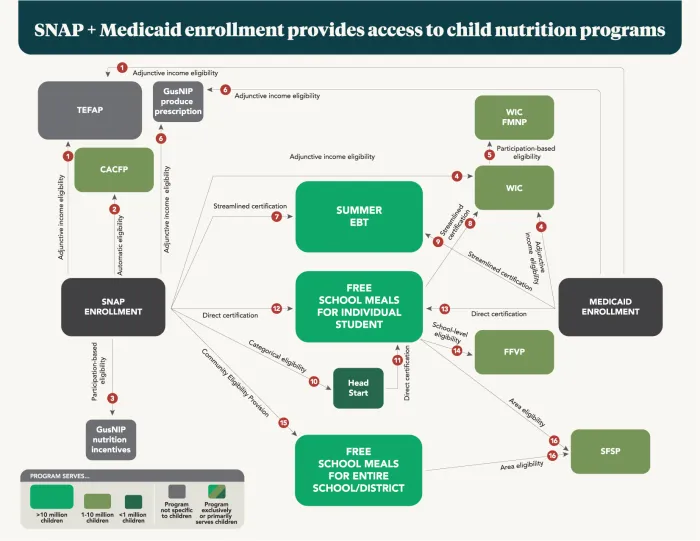
But cuts to SNAP and Medicaid don't just affect those program participants—they can also undermine children's access to school meals. That’s because enrollment in either SNAP or Medicaid automatically qualifies children for free school meals and other nutrition programs. It also helps make viable the community eligibility provision (CEP), whereby community poverty levels can allow all students to receive free school meals. As a result, when families lose access to SNAP and Medicaid, their access to other nutrition programs is also at risk or, at minimum, hindered by the additional burdensome applications required to reenroll in free school meals. The cascading effects of cuts to SNAP and Medicaid mean that the 1.5 million children and counting who’ve already lost access to SNAP will also lose automatic enrollment in free school meals.
For the full impact of how program eligibility is linked, see the diagram below.
The blunt reality is that any improvements in school meal quality will accrue mostly to children from households who can afford to pay for school meals—and are thus already more likely to have better diet quality. School districts in low-income areas are already forgoing serving free school meals to all children because it’s no longer financially viable. In Arizona, where every county has seen child participation in SNAP decrease by a third, it’s estimated that the state could see almost 200 schools lose CEP eligibility. In Illinois, another hard-hit state, 47 fewer schools and 15 fewer districts are participating in CEP this school year compared to 2025. This is just the start—these devastating losses will be replicated in state after state as SNAP participation continues to fall and as families are subjected to new Medicaid work requirements starting in January 2027, further compounding the loss of automatic eligibility for free school meals.
Increasing participation in school meals through CEP or free school meals for all gives schools greater buying power to purchase healthier ingredients and invest in the equipment and staff needed to prepare them. It also reduces the administrative burden of processing applications, as individual applications are no longer mandatory under CEP, thus freeing up resources to instead focus on farm to school programming and cooking meals from scratch. In other words, expanding access to school meals can help schools reach the administration’s goal: serving less-processed, more nutritious food.
We cannot build a healthier food system for children if we strengthen school meals with one hand while we dismantle the programs that feed them with the other. Every child in this country, regardless of income, needs access to healthcare and nutritious meals at home and school in order to thrive.
Erin Ogden (she/her/hers) supports CSPI's federal child nutrition policy efforts through cultivating a strong, nationwide network of grassroots advocates and contributing to CSPI's array of advocacy resources.
Cassie Harrison-Ramos (she/her/hers) work focuses on SNAP policy and healthy food access for families with low incomes. She works with partners and community-based groups to engage with SNAP participants about strategies for maximizing nutrition security.
Donate to CSPI today
CSPI heavily relies on our grassroots donors to fuel our mission. Every donation—no matter how small—helps CSPI continue improving food access, removing harmful additives, strengthening food safety, conducting and reviewing research, and reforming food labeling. We don't take donations from corporations, and our flagship publication, Nutrition Action, doesn't run any ads. That means that everything we do is fiercely independent and unbiased from any bad actors, no matter how powerful. To help keep this online content 100% free, consider donating today to support CSPI.