

Dietary Guidelines for Americans
The Dietary Guidelines for Americans contains the federal government's basic healthy eating advice for its citizens, and forms the basis of many federal, state, and local nutrition policies.
Updated once every five years, the Dietary Guidelines for Americans is published jointly by the U.S. Department of Agriculture and the Department of Health and Human Services. The current edition, the 2020-2025 Dietary Guidelines for Americans, was released on Dec. 29, 2020.
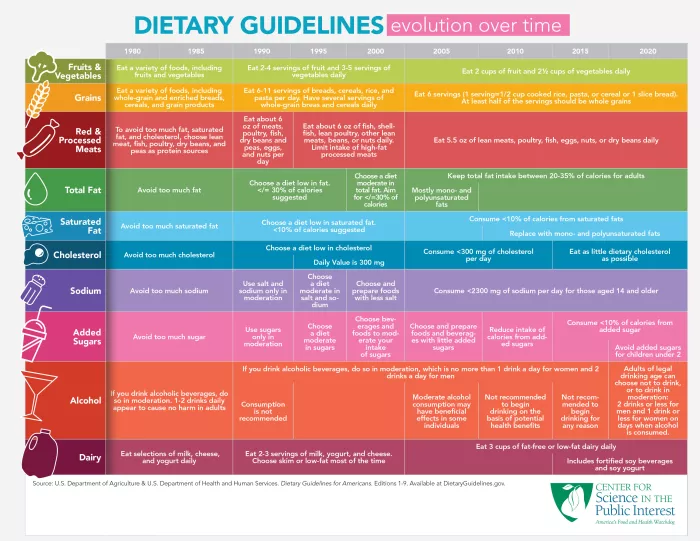
Much of the Dietary Guidelines' core advice has remained consistent over the last 40 years. It typically calls on Americans to consume more fruit, vegetables, and whole grains, and less refined grains, added sugars, salt, and fatty meat.
While some have actually blamed the Dietary Guidelines for public health problems, the truth is that Americans have not, nor do they now, eat according to the Guidelines. That's why we support policies to help Americans eat healthy diets that are more in line with the government's generally sensible advice.
Frequently asked questions about the Dietary Guidelines
The Dietary Guidelines for Americans (DGA) is the most powerful scientific document that too few Americans have heard of. Below, read about the role of the DGA in our nation's health.
Key resources for understanding the Dietary Guidelines

2025-2030 Uncompromised DGA
The purpose of The 2025-2030 Uncompromised DGA is to demonstrate what the federal government’s overarching Guidelines for healthy dietary patterns could have looked like if the Trump administration had not strayed from its mandate to publish clear, detailed, evidence-based Guidelines. Policymakers, advocates, health professionals, and consumers can use this integration of the 2025 DGAC’s science-based recommendations to guide public health policy and individual decisions.
Read more
Is saturated fat good or bad?
The Dietary Guidelines for Americans and other health authorities have long recommended limiting your intake of saturated fat, in part by choosing low or non-fat dairy. Maybe you’ve heard that saturated fat isn’t actually harmful…or that it’s fine if it’s from dairy. We’re here to clear up the confusion and answer your questions about saturated fat.
Read more
What are the Dietary Guidelines, and why do they matter?
If someone asked you what you’ve heard about the Dietary Guidelines for Americans, would you know what to say? You’ve probably heard of the Food Guide Pyramid (which hasn’t been used in about 15 years), and you might have recently heard something about the Guidelines being the cause of America’s health woes (not true). We’re here to set the record straight.
Read more
How are the Dietary Guidelines developed?
We all have had the experience of trying to figure out what foods we should eat to stay healthy. Is a glass of wine okay? What about eggs, olive oil, red meat, or whole milk? And if it’s so confusing to decipher all that for just yourself and your family, how does anyone figure it out for the whole country? We’ll introduce you to the experts who handle that work and tell you how they do it.
Read moreKey takeaways from the 2020-2025 Dietary Guidelines for Americans
Overall, the 2020-2025 DGA recommends eating a diet that is rich in vegetables, fruits, protein foods (including beans and nuts), whole grains, low- or non-fat dairy foods, and unsaturated vegetable oils, and that limits saturated fat, sodium, and added sugars.
The core elements of this healthy eating pattern can be modified to accommodate one's budget, cultural traditions, and personal preferences.