Safe grilling: How to avoid food poisoning at cookouts
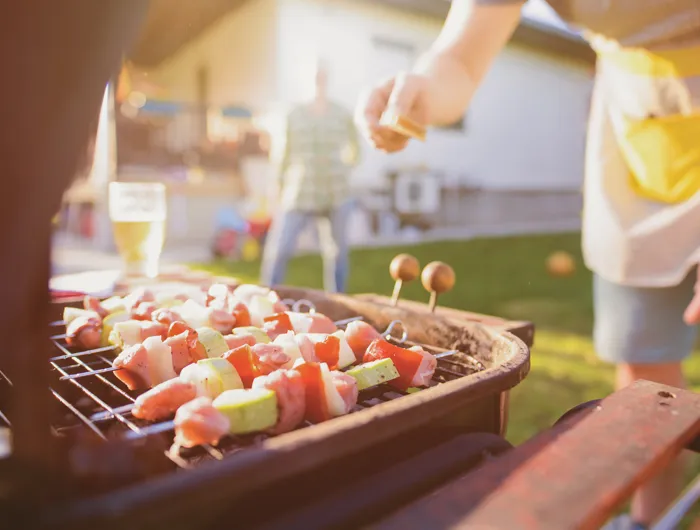
Dusan Petkovic - stock.adobe.com.
Grilling or cooking to feed a crowd at your next barbecue, potluck, or picnic? Food safety matters more than you might think. It’s not just about keeping your food from making you sick. If you or any of your guests are over 65 or under 5, are pregnant, or have a weakened immune system, they’re at higher risk for more severe illness from food poisoning. We have answers to common questions about marinating, thawing, grilling, and serving food safely.
Q: How should I thaw and marinate?
The short answer: In the fridge, not on the countertop. That applies to both thawing and marinating (or brining) meat, poultry, or seafood.
Why? Leaving perishable food on the countertop to thaw or marinate keeps it in the “danger zone”—between 40°F and 140°F—for too long. Between those temperatures, bacteria like salmonella and E. coli multiply more rapidly and can grow to levels that cause food poisoning. To play it safe, never keep perishable food out of the refrigerator or freezer for more than 2 hours (that rule also applies after you’ve cooked it).
Thawing
Thawing frozen food in the fridge can take a day or more. What if you don’t have that much time? You have two safe shortcuts, says the USDA:
Got a few hours? Thaw in cold water. If the meat isn’t in a leakproof package, transfer it to a zip-top plastic bag. (That way, the meat won’t absorb water and get soggy.) Then submerge the package or bag in cold tap water, changing the water every half hour so that the meat continues to thaw. Expect a one-pound package to take about an hour to thaw.
Got just a few minutes? Thaw in the microwave. Transfer the meat to a microwave-safe container, then heat on the defrost setting until fully thawed. A word of caution: Some areas of the meat may get warm enough in the microwave to create bacteria-friendly “danger zone” hot spots, so grill the meat immediately after you microwave-thaw it.
Whatever method you choose, don’t rush thawing. It’s not just about safety. It also helps make sure the meat grills evenly. And never put meat that’s still partly frozen in a smoker. It takes longer to thaw at low smoking temperatures, so the meat could remain in the “danger zone” for too long.
Marinating
To prevent cross-contamination of other foods with raw meat or poultry juices, marinate them in a covered container in the fridge. And don’t reuse the marinade—for example, brushing it on the meat while it cooks—unless you boil it first to kill any bacteria that may be present.
Tip: If you plan to use extra marinade as a sauce or dressing, set a portion of it aside before you start marinating.
Q: Are burgers done cooking when they’re brown?
You can’t judge grilled meat by its color.
“It’s not a good indicator for what’s actually happening inside of that food,” cautions Lester Schonberger, an associate extension specialist in the department of food science and technology at Virginia Tech.
Take ground beef, which “can undergo premature browning,” says Schonberger. “It looks like it’s done, but in reality it’s undercooked and would be riskier for you to consume.”
How might that happen? Factors like beef’s pH, iron, and “myoglobin” protein—as well as how it’s been stored and packaged—determine whether the raw meat looks bright red or grayish brown before it ever touches the grill.
“For example, raw ground beef that has been stored for a longer period of time or has been stored at temperatures above 40°F will look more brown,” explains Schonberger. “So there isn’t that same conversion from red-colored meat to brown-colored meat as it cooks.”
In other cases, the meat can still look pink even though it’s cooked to a safe temperature.
Is it done yet?
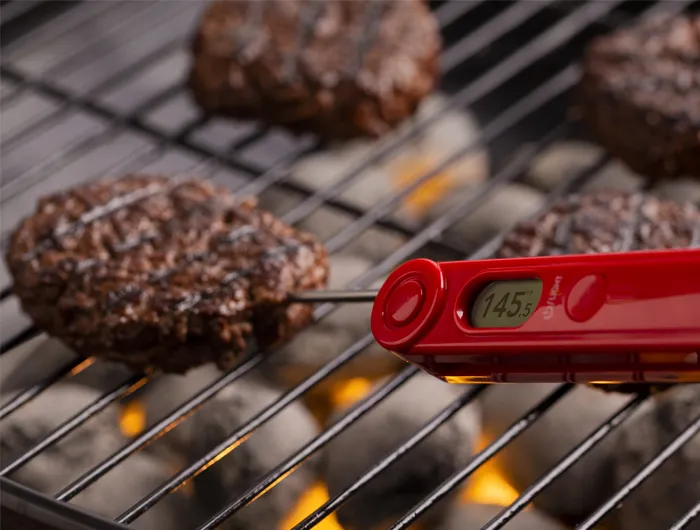
It’s best to insert your food thermometer through the side of a burger patty so that it stays in the center of the meat (the coolest part). That way, the probe won’t poke all the way through and hit the grill’s hot air.
mphillips007 - iStockphoto.com.
The only surefire way to tell if meat, poultry, or fish is done on the outside and inside? Use an instant-read food thermometer to check that the thickest parts have reached these safe minimum internal temperatures.
Q: I’ve been grilling without a meat thermometer for years. Why should I start now?
“I don’t want to discount learned experience and intuition,” says Schonberger. But it's a good idea to verify with data, he notes. Checking the temperature of grilled foods takes only a few seconds with an instant-read food thermometer.
“In my opinion, that’s worth the hours you might otherwise have to spend on the toilet or on a hospital visit from food poisoning. And when it comes to your cookout, you’re not just preparing food for yourself anymore.”
Some of your guests “could be especially vulnerable to significant effects of foodborne illness,” notes Schonberger. If they’re over 65 or under 5, pregnant, or have a weakened immune system, a bout of food poisoning could lead to hospitalization or, in some cases, death. Causes of a weakened immune system include an autoimmune disorder (like lupus), alcohol use disorder, chemotherapy or radiation treatments, and diseases like diabetes, kidney disease, liver disease, or HIV.
Another plus for thermometers: They don’t just prevent undercooked food; they also help prevent overcooked food. If you take your meat off the grill as soon as it hits the magic number, it’s more likely to turn out juicy and tender, not dry and tough.
Q: How should I clean my grill?
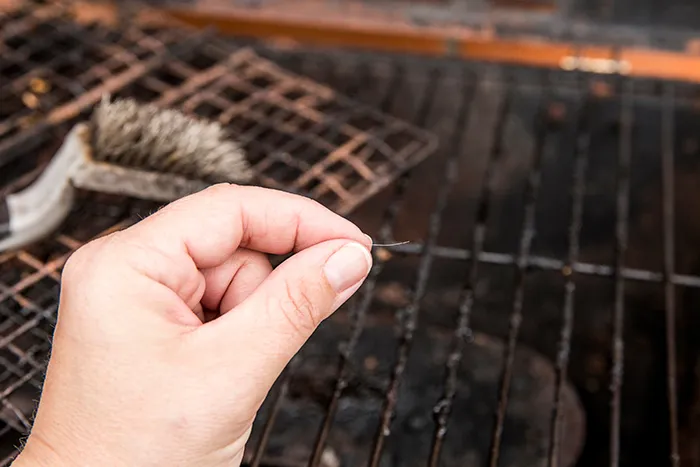
Wire grill brushes sometimes leave stray bristles behind. If they get stuck to grilled food, that can spell trouble.
FotoHelin - stock.adobe.com.
Scraping your grill’s grates clean helps remove old char and grease and prevents food from sticking. But wire brushes can leave stray bristles behind. And that can lead to a no-fun trip to the ER.
From 2015 through 2023, an estimated 3,700 people ended up in US emergency rooms after accidentally swallowing wire bristles that were stuck to grilled food. In some cases, the bristles have lodged themselves inside the throat, abdomen, or elsewhere and caused infections or damaged blood vessels or poked holes in intestines.
And just this past February, grilling giant Weber recalled more than 3.2 million wire brushes because of a few dozen reports that their bristles detached or were swallowed. The company told customers who had bought the brushes to contact them for a new brush with nylon bristles that’s designed for “cold cleaning”—that is, cleaning an unheated grill.
Other alternativetools include a grill stone, a coil-shaped bristle-free brush, or a wad of crumpled-up aluminum foil held with tongs. (Not sure whether a tool is suitable for your grill’s cooktop? Consult the grill’s owner’s manual or customer service department.)
If you do use a wire bristle brush:
Wipe your grill with a wet rag after brushing to mop up any debris
Inspect your brush before using it and replace it when bristles look worn
Consider replacing your brush every year
Q: Is it safe to reuse my platter or utensil?
Nope. Raw meat, chicken, or fish transfers any bacteria to whatever platter or plate you use to tote it out to the grill. To avoid that cross-contamination, be ready with a second, clean platter to collect cooked food. The same goes for the tongs, spatula, or fork that you used to place raw meat on the grill or turn the meat over—have a spare on hand.
Q: Should I throw out cooked clams that don’t open?
hyungmin - stock.adobe.com.
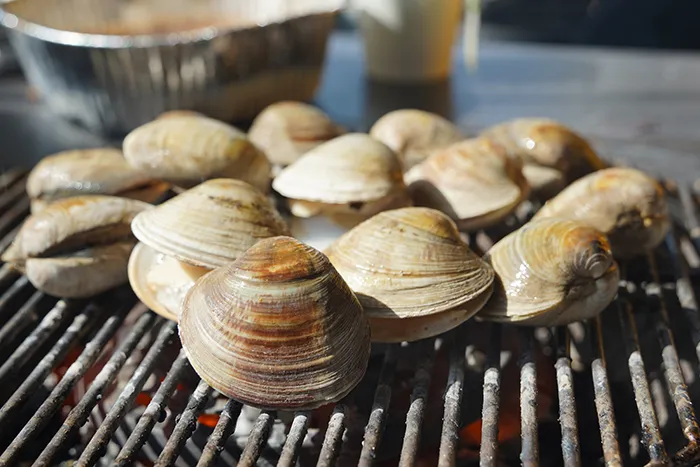
Planning a seafood boil or tossing some clams, mussels, or oysters on the grill? You might have heard the age-old advice to throw them out if they don’t open when cooked. That’s based on more than just belief.
“Live shellfish keep their shells tightly closed using muscle tension, and heat during cooking denatures those muscles, causing them to relax and the shells to open,” explains Mengyi Dong, an assistant professor and extension specialist with the Virginia Seafood Agricultural Research and Extension Center.
“However, if a shell stays shut, it may indicate the animal was dead before cooking and the muscle did not respond to heat.” And dead shellfish are more likely to spoil quickly and harbor bacteria or toxins that could make you sick.
That advice mainly applies to fresh, live shellfish, not to frozen products. Freezing can damage the muscle that opens and closes the shell. “So frozen shellfish may or may not open during cooking, and shell opening alone is not a reliable indicator of safety in that case,” says Taozhu Sun, another extension specialist with the Virginia Seafood AREC.
What else can you do? Follow the FDA’s recommendations for buying, thawing, and cooking seafood safely. Among those recommendations: Pay attention to how seafood looks and smells.
“Uncooked spoiled seafood can have sour, rancid, fishy, or ammonia odors. These odors become stronger after cooking,” says the FDA’s website, which advises:
If you smell sour, rancid, or overly fishy odors in raw or cooked seafood, don’t eat it
If you smell an ammonia odor in cooked seafood, don’t eat it
Q: How long can food sit outside in the sun?
Timothy - stock.adobe.com.
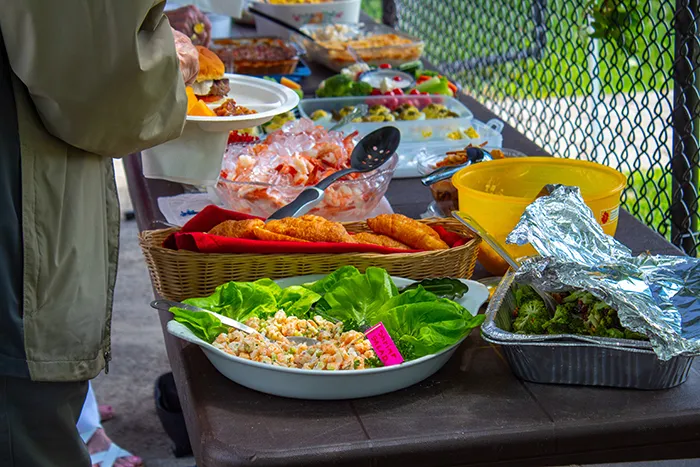
It’s safest to limit the time perishable foods spend unrefrigerated (or out of a cooler) to no more than two hours...or one hour if it’s above 90°F. Keep in mind that all prepared foods matter. Have you heard that only mayo-based salads are at risk if they sit out too long? That’s a myth. It’s also salads of all kinds, as well as cut fruit, cheese, meat, leftovers, etc.
That said, a one-to-two-hour window is tight in real life. If you need to have food on offer for longer, try to serve helpings of it in smaller serving dishes that you can replenish as needed. To extend your safe timeframe, you can place serving dishes on ice or keep some foods in sealed containers inside of a cooler packed with ice (stow it in the shade, if possible).
CSPI heavily relies on our grassroots donors to fuel our mission. Every donation—no matter how small—helps CSPI continue improving food access, removing harmful additives, strengthening food safety, conducting and reviewing research, and reforming food labeling. We don't take donations from corporations, and our flagship publication, Nutrition Action, doesn't run any ads. That means that everything we do is fiercely independent and unbiased from any bad actors, no matter how powerful. To help keep this online content 100% free, consider donating today to support CSPI.